Starward is on the hunt for Australia’s best New Old Fashioned — a cocktail that captures the flavour, creativity and modern Australian spirit at the heart of our whisky. The winning drink won’t just earn bragging rights: it will be bottled, labelled and released nationwide, giving one bartender the rare chance to see their creation become part of Starward’s story. The winner also receives a two‑day hosted trip to our Melbourne distillery.
We live in delicious times. The quality of bartending — and cocktails in particular — has never been higher. These days you can get a pretty good Old Fashioned in most bars, often even at the local pub.
But how do you take that Old Fashioned formulation, update it, put your spin on it, and then bottle it for the masses?
That’s what Starward’s New Old Fashioned competition is seeking to find — a bartender-created take on the Old Fashioned that they can partner with and commercialise. It’s an amazing opportunity for bartenders to take their drinkmaking philosophies, their favourite flavours, and their talents, and to see just how much appeal they’ll have on a bottle shop shelf.
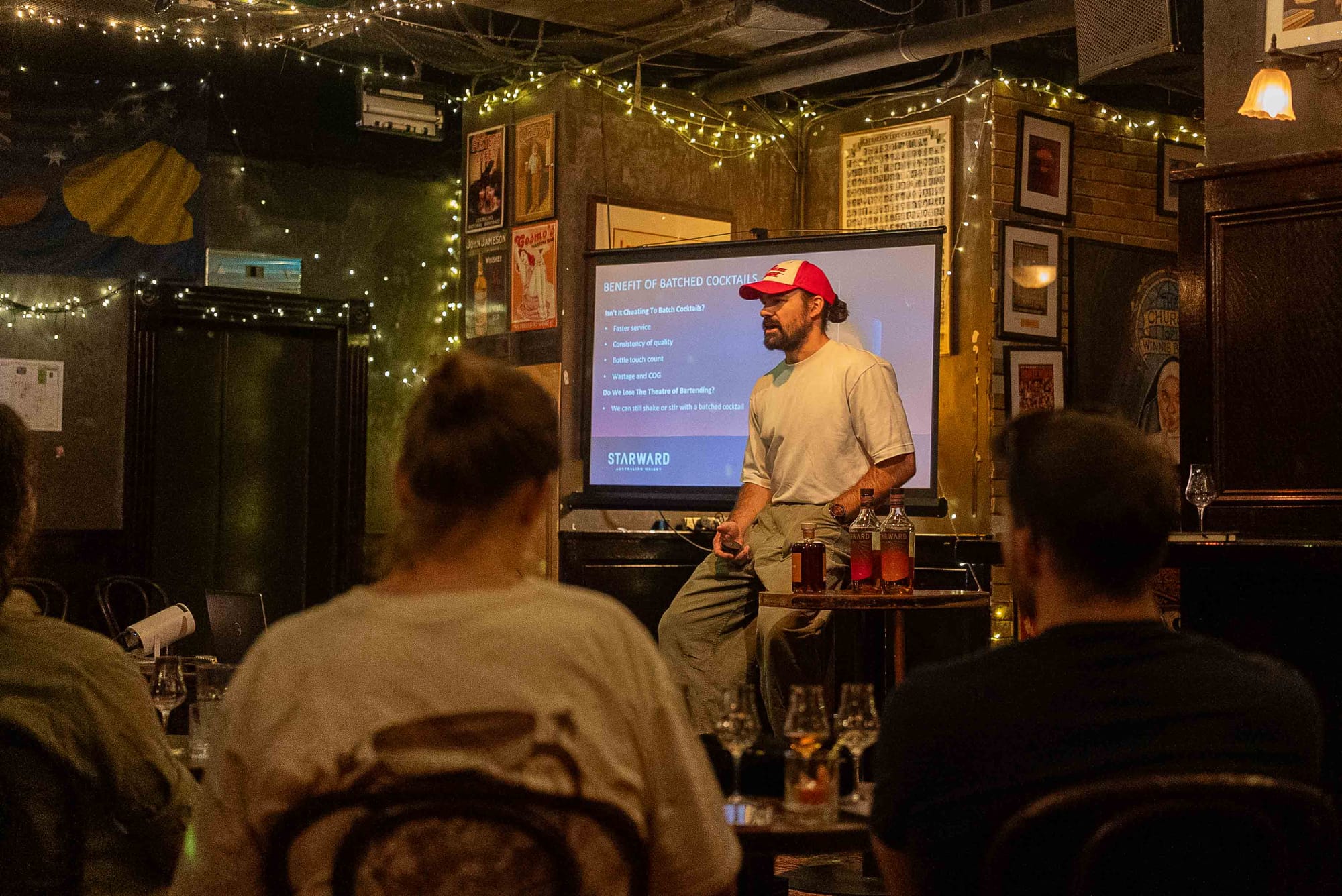
But making a cocktail that is suitable for bottling and distributing around the country isn’t as simple as batching your drinks for service, as award-wining bartender Tom Opie (Pilot, Canberra) pointed out in a Starward masterclass recently.
“You can batch anything,” he says, but there are some things you’ll want to consider if that drinks has to live on a retail shelf: citrus oxidises, sugar ferments, milk splits.
So below, we’ve got some tips from Tom’s masterclass on making a great bottled Starward Old Fashioned, and more information on how you can enter.
Let’s get into it.
New format, new competition
First, let’s see what you’ve got to do to enter the competition — registrations close June 30, by the way — and what you can stand to win.
The prize first: the winner will receive a two day trip to Starward’s Melbourne distillery, a blending master class with their award-winning master distiller Carlie Dyer, and the bragging rights of being the bartender with their own bottled, labelled, and distributed bottle cocktail in collaboration with Starward.
What’s even better, you’ll receive 50 percent of the net profits from the sales of your bottled Old Fashioned for the first six months.
The winning venue, by the way, will receive three cases of the winning bottled cocktail for their bar.
Here’s what to avoid
As Tom Opie suggests in the quotes below, there are a few things that are immediate non-starters when it comes to thinking about the recipe for your bottled cocktail.
1. No dairy (unless it’s clarified).
TOM OPIE: “Don’t use milk in a batch unless it’s clarified. It’s gross.” That creaminess you get from dairy is a crowd-pleaser, for sure, but then as Tom says, “the fat will be heavier than the [rest of the] liquid, and you can’t get the consistency.”
2. No citrus unless clarified.
TOM OPIE: “Oxidases are when the enzymes [in citrus] hit oxygen, they start to degrade immediately.” This means that even fresh-pressed, vac-sealed lime degrades over time.
3. Nothing with sugar unless the ABV is high enough — or it ferments.
TOM OPIE: “Anything with sugar, and if it’s not high enough alcohol percentage, it will ferment. Sugar obviously attracts yeast.” There is a reason that champagne makers give their wines a dosage of sugar — that’s what causes the secondary fermentation. You don’t want your bottled cocktail exploding on shelves.
How to make things shelf-stable
Higher ABV = more microbial resistance.
TOM OPIE: “Higher ABV will kill the microbes… and you get a nice stable drink.”
Alcohol is a great preserver in this respect. This is why all those non-alcoholic ‘spirits’ have use by dates on them — and true spirits do not.
Clarification stablises.
TOM OPIE: “Clarification strips the proteins, the fats and the enzymes that [otherwise] allow the drink [to] oxidise. So that’s why when you clarify a drink it lasts forever — or at least it doesn’t really change unless it gets hot.”
Sterilise everything — vinegar, then boiling water.
TOM OPIE: “Make sure your equipment is all sterilised.v Sterilise things with vinegar and boiling water… just to make sure there’s no other bacteria and in it.” This one, we think, is pretty self-explanatory.
Keep it cold and minimise head space.
TOM OPIE: “Make sure it’s cold. Minimise head space [in the vessel you’re using], and make sure the thing’s real full. Otherwise again, there is more space for CO2 and sugar to do their thing.”
How to make a drink cost-effective
Use offcuts from the kitchen.
TOM OPIE: “I’ve crafted a menu that is entirely offcuts from the kitchen: orange peels, melon skins, whatever it might be. I haven’t bought anything in for Such and Such so far over my six months.” It’s a way to keep your costs down, and a good practice to have as standard operating procedure anyway.
Employ nixtamalisation to pull more flavour from husks and shells.
TOM OPIE: “I’ve been playing with a technique called nixtamalisation, which is basically what Mexican people do to create maize flour.” How does that work in practice? “I’ll take the snow pea shells from our chefs, and when they [blend] they taste like snow peas, because all the hard, bitter stuff is just a barrier for the fruit or vegetable.” There is plenty more flavour to be found in your ingredients.
Build acid back in, instead of buying citrus.
TOM OPIE: “I’ll research the acid profile of the raspberry and calculate the percentage of citric and malic [it contains] and then I’ll add that back into the mix.”
The added bonus is that acid also helps to stabilise your drinks.
Reduce waste and labour costs.
TOM OPIE: “Reduce waste, keep an eye on labour of course — you’ll need less people behind the bar when you batch everything.”
Starward is on the hunt for Australia’s best New Old Fashioned — a cocktail that captures the flavour, creativity and modern Australian spirit at the heart of our whisky. The winning drink won’t just earn bragging rights: it will be bottled, labelled and released nationwide, giving one bartender the rare chance to see their creation become part of Starward’s story. The winner also receives a two‑day hosted trip to our Melbourne distillery.