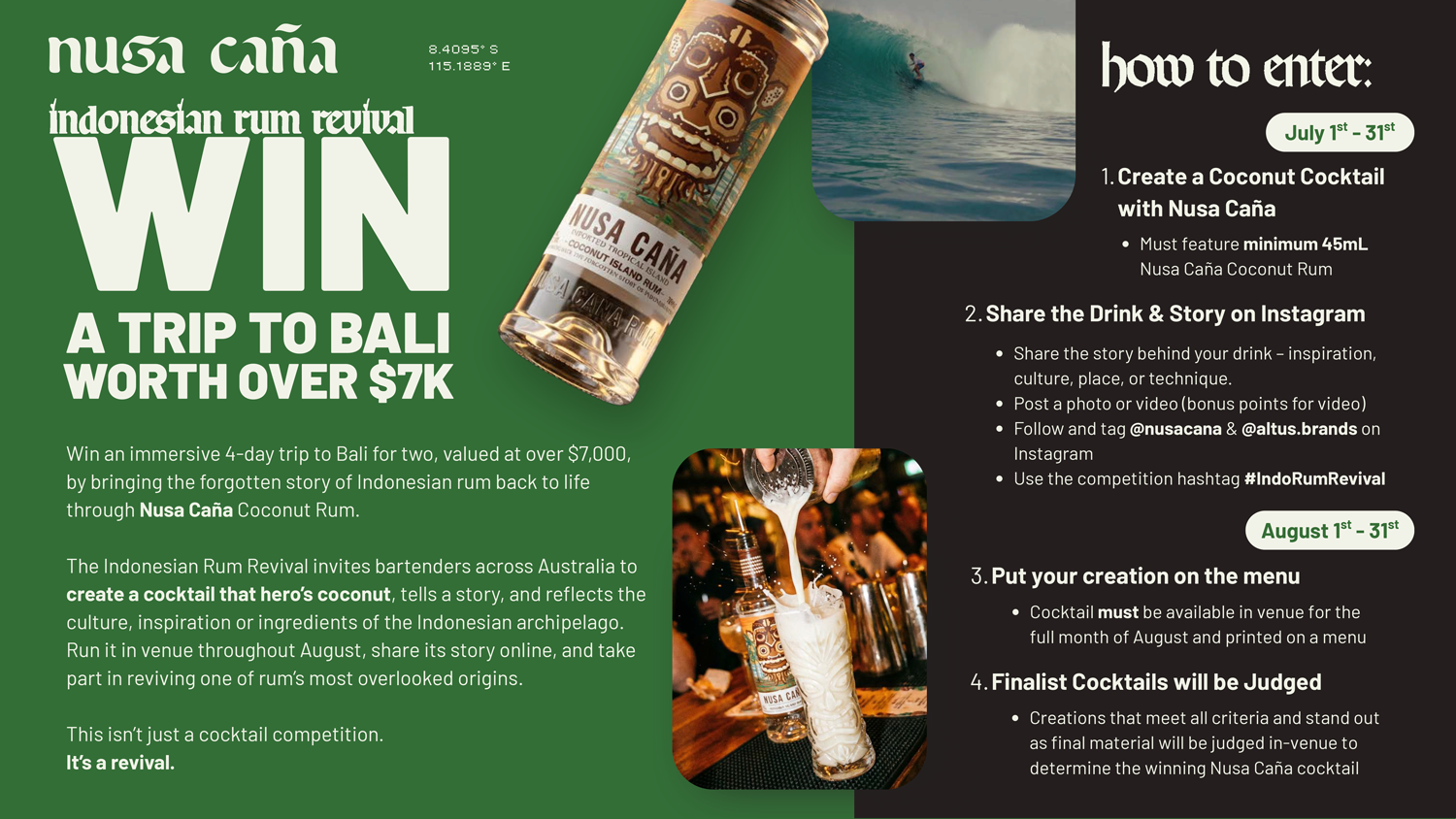
Fancy picking up a trip for two to Bali worth over $7,000 — and gaining a deeper understanding and appreciation for Indonesian rum and Nusa Caña along the way? The Nusa Caña Indonesian Rum Revival is open now, with entries closing tomorrow, Friday 31 July. For more information, hit the button below.
I think about the first time the character Freddie Miles appears in The Talented Mr. Ripley. He screeches into the piazza in a red Alfa Romeo, steps over the door, helps himself to someone else’s glass of wine, then swiftly exits with his entourage as he ‘has a table outside at Fabrizio’s’. It’s not charm, but he moves like consequences are for other people, and from a distance it reads, almost convincingly, as freedom.
That is why I rewatch it. Beneath the plot, it is selling escapism: a version of life where time stretches, plans are instinctive, and the day feels permanently lit from the side. I want the clothes, I want the spontaneous detours to nearby towns to listen to jazz. I am still searching for the watch strap Jude Law’s character wears, as if it could unlock the right afternoon. I want every hour to be golden.
Drinking is often the same kind of wish. Us bartenders tend to dress it up in language about flavour, craftsmanship, provenance and technique but a drink is usually a small act of self-editing. Guests order a feeling. A Martini is composure. Whisky is gravity. Champagne is celebration. The Spritz is escape.
It’s a particular kind too. The Spritz sells the fantasy of elsewhere. Something Italian, or at least Italian-adjacent. Something sunlit. Something that belongs to late afternoons and the idea of leisure. Even those who have never sat al fresco in Milan understand what it is meant to represent. A table outside. The slow drift of conversation. The sense that nobody is rushing you. Many people have had one on holiday. Others have absorbed the idea secondhand, through menus and pictures, a film perhaps, and the way the drink is always framed as light, bright, and vaguely continental. Either way, it arrives carrying a memory that may not be theirs but feels usable. The Spritz is a postcard.
That is why the Spritz has become a category rather than a single recipe. It is also why the category has now become unruly. When a drink becomes a symbol, people start using the symbol loosely. ‘Spritz’ starts to mean ‘long and fizzy’ or ‘light and bubbly’. It becomes a label you can slap on anything cold and cheerful — then charge a premium for. And once that happens, the feeling that made it powerful in the first place begins to weaken. Not just because bartenders care about definitions, but because guests do too, even if they cannot articulate it. A drink that promises escape needs to deliver something specific. If it does not, it does not simply taste wrong, it feels wrong.
So here is the law of The Spritz, delivered as gently as I can.
First, it is wine based: sparkling wine, still wine, aromatised wine, fortified wine, all admirable foundations.
Second, it must have carbonation. Traditionally that comes from sparkling wine and a splash of soda, but the method is not the point. Carbonation is not decoration but structure. It keeps the drink bright, lifts aromatics, it provides acid and stops bitterness from feeling heavy.
Third, it must whet the appetite. This is the rule that saves the whole category from turning into adult cordial. A Spritz is an aperitivo. Its job is to sharpen you, not blur you. It should make you want snacks, olives, chips, anchovies, dinner.
Fourth, seasoning is allowed, but it cannot become the star. A spirit can appear, but only as an accent. Citrus juice can appear, but only to tie it altogether if needed. Like salt in cooking, it is there to clarify and lift, not to announce itself. If the accent becomes the headline, you have crossed into another category, and the word ‘Spritz’ starts losing meaning again.
These rules are not meant to limit creativity but to protect the promise. The Spritz is successful because it delivers a very specific experience: bright, bitter, sparkling, civilised. The drink that makes you feel like you have all the time in the world, without taking tomorrow away from you.
The history, for what it is worth, can be kept to a paragraph. It began as an Austro-Venetian habit of softening local wine with a splash of water, then evolved into a modern aperitivo ritual in the Veneto, later propelled into global fame by the mid-century rise of Aperol. Done. The rest of the story is not about origin. It is about why it fits the way people live now.
The Spritz is popular because drinking has shifted from intensity to control. We used to treat strength like value, nights built to peak, spill over and be recovered from. The Spritz rejects that narrative and offers the theatre of a proper drink without the collateral damage. This matters because modern life is crowded. People are driving, parenting, training, working late, and arriving tired. The Spritz suits our current reality because it is designed to be lived alongside, not recovered from.
It also says something about taste. Bitterness, not long ago, was the private language of bartenders. Amari, quinine, gentian, Fernet, the ‘bartender’s handshake’. The Spritz made bitterness accessible by giving it bubbles and ritual and daylight. It did not ask our guests to learn the history of aperitivo culture. It simply offered a sensation that made sense in the body: appetite, brightness, that clean snap on the finish. In doing so, it trained palates.
Ritual is part of it too. The Spritz is recognisable from across a room. Its structure is comforting. People cling to small ceremonies when the larger culture feels uncertain, and the Spritz has become one of those ceremonies. It is not popular because it is the most technically impressive thing on a menu. It is popular because it offers a believable version of elsewhere. It tastes like a particular kind of life, one that feels just out of reach and therefore worth ordering into existence. You are not just drinking before dinner. You are having ‘an aperitivo’ whilst looking at the wine list. You are someone who takes your time. You are, briefly, the person you might be in another city, in another season, with better light and fewer obligations.
That is the real service the Spritz provides. Not fizz. Not orange. Not branding. It is a permission slip. The same kind Freddie Miles appears to carry, for better and worse, when he enters the frame as if the world were made for his enjoyment. Most of us are not trying to become Freddie. But most of us do want a little of what he represents in that first impression: the sense that life could be lighter, that the afternoon could stretch, that consequences could wait.
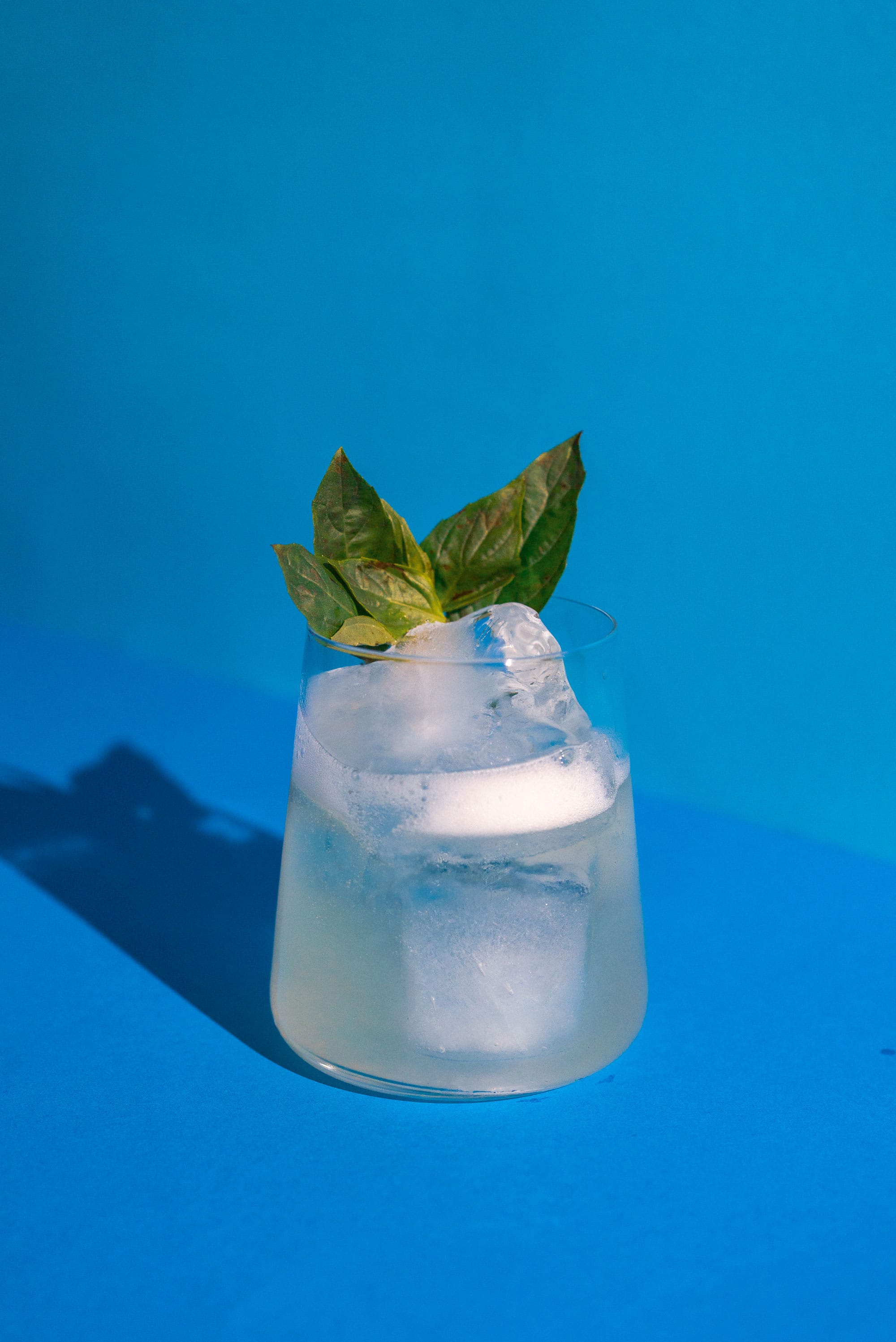
Belafonte Spritz
Ingredients:
- 20ml fino sherry
- 20ml lemon juice
- 15ml Tanqueray No. 10
- 15ml sugar syrup (1:1)
- 70ml prosecco
Method:
Shake all ingredients except the prosecco, and pour into a wine glass over ice, and top with prosecco. Garnish with Thai basil.
Recipe by Charlie Ainsbury, This Must Be The Place