
In this issue:
- Why we’re writing about Singapore and its bar scene and bartenders;
- The Two Drink Review — Players Table: a brief review of the new Aliwal Street cocktail bar;
- What to expect when — Bar Kap is set to open in June; here’s what you need to know;
- The Last Word — what’s on in Singapore and beyond.
Welcome to the first edition of Boothby’s Singapore briefing, coming direct to your inbox each week.
First up, a little about why we’re doing this, and a little about me. Boothby began in Sydney, Australia, during the heady and uncertain days of 2020. I started this because I was tired of seeing the press release-based churnalism which passes for as much of the bar industry media these days. I know bartenders, I started my career as a bartender, and I thought then — and I still do — that bars and bartenders’ contribution to the food and drink culture is under-appreciated. That’s what motivates us at Boothby.
And the bar and drinks world is increasingly a global one. I am a big believer in bartenders being able to travel, whether it’s for guest shifts or to move jobs — the result is that the drinks get better the more bartenders interact with likeminded people around the world. And I think it’s becoming harder to fully understand Australian bar culture without understanding the bar culture in Singapore, in Bangkok, and across Asia more broadly. So we’re on a mission to understand more, to unpack what is happening in the bars of Singapore, to explore what is behind the success of the city’s best bartenders and bar operators. To start, I’ll be writing this newsletter each week; I’ve been on the ground in Singapore three times this year and I’ll be back at the start of June — I’d love to say hello if you see me out and about. And we’ll be looking for a Singapore-based correspondent to take over this newsletter in the coming months, so if you know someone we should talk to, please drop me a line.
For now, you’ll be able to access all our Singapore and Asia stories at boothby.asia, along with each edition of this email briefing. And in the meantime, do give us a follow on Instagram at @boothbydrinks, and send any tips, intel, or feedback to me direct at sam@boothby.com.au. I’d love to hear from you.
What to expect when Bar Kap opens in June
When Bar Kap opens to the public in June, it will be merely the latest chapter for a building with a history that not just pre-dates modern Singapore, but goes back to the 1880s — and one that has been designated as a national monument.
The project, led by Bobby Carey and Tom Hogan’s new bar consultancy firm Studio Ryecroft, takes residence in the grand mansion built by Tan Yeok Nee. The House of Tan Yeok Nee is the last example of a Singaporean Teochew courtyard grand mansion, and was where the tycoon lived until the turn of the last century. The building was then used for other purposes over the last 140 years: it was the house of the railways master before World War Two; it then became a Salvation Army headquarters after the war, until 1991, when it was briefly a traditional Chinese medicine hall and a university. In 2022, the Kareem Family Foundation secured the site and set about restoring it to its former glory.
And they also decided — wisely, if you ask us — to put a bar into the part of the complex which once served as Tan Yeok Nee’s living quarters.
We had a walkthrough in the lead up to opening with Carey, and asked him what we should expect from Bar Kap when the doors open on June 8th — here’s everything we know.
What’s the big idea behind Bar Kap?
“We wanted something that’s got longevity,” Carey says. “This [building] has 140 years already, so Bar Kap is gonna be here for a long time. You can’t do something that’s gonna need to change in five, six years — it needs to be locked in.”
The bar is led by cocktails, with a menu divided into eras inspired by the history of the House of Tan Yeok Nee.
What about the food?
A lot of care and attention has also gone into the food offering. Carey’s recommendation? “I’m trying to push the noodles,” he says. “There’s nothing better.” That’s because they’ll be making the hand pulled and cut noodles in house.
“There will be a beef fermented black bean noodles, which I think is going to be a banger,” Carey says. “If you want to come in and have a full dinner here, absolutely can do it. It’s all designed to share.”
What’s the room going to look like?
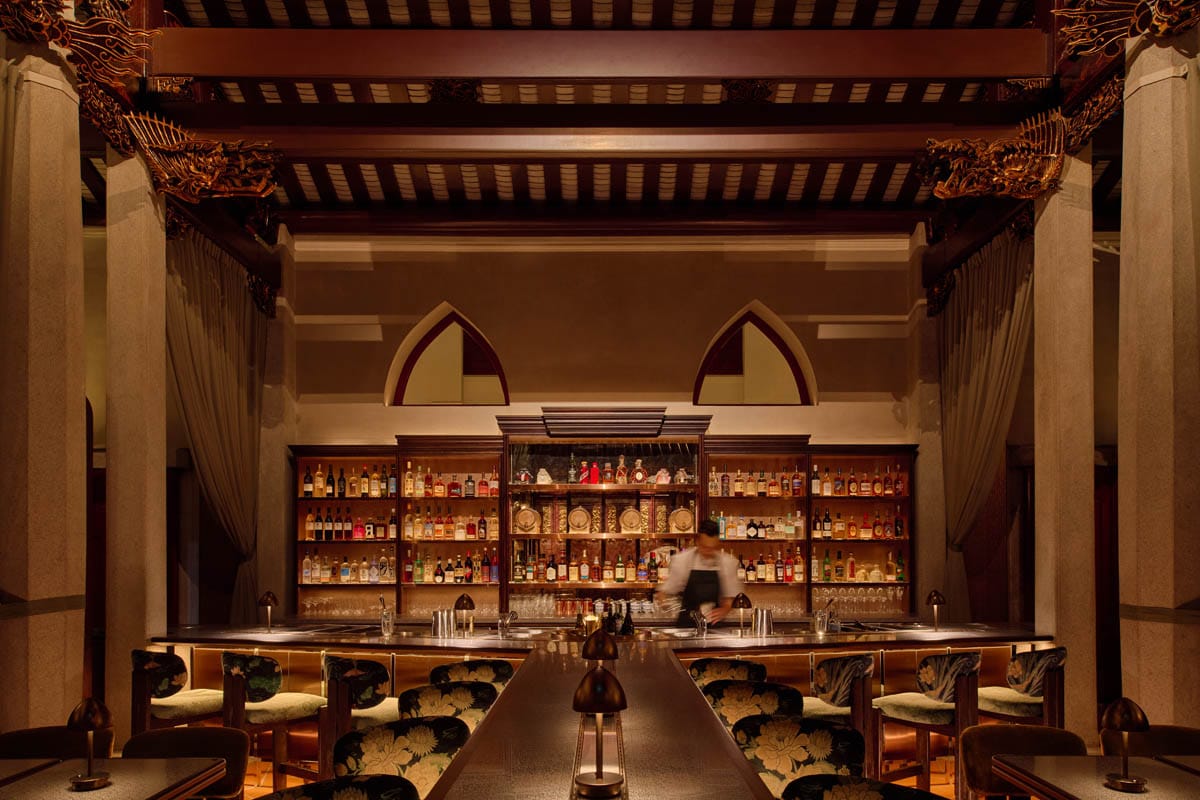
The aesthetic of the room draws inspiration from the 1880s, and when you step inside the room in which Bar Kap resides, you’ll see a Y-shaped table running up to the bar.
“It’s going to feel more like someone’s home as you go through,” says Bobby. “This is a quite unique Y-shaped bar because we wanted it to be like a living room. We wanted it to feel like everyone’s coming in and welcome.”
And down the length of the Y-shaped that extends out from the bar — and this is the thing bartenders will froth over — is a cold plate upon which drinks can be kept at the right temperature. “It’ll keep your drinks ice cold,” says Carey.
The room features seating of varying heights and of different capacities. The tables feature a patterned mirrored surfaces, which allows everyone to look up and see the decorated ceiling. “Whenever you sit down, you’re looking up,” Bobby says.
The bar itself is a two station design, with foot-operated taps. “It’s quite intuitive,” says Bobby. “It’s not a laboratory mixology bar.”
Off to the right of the main room is a smaller, slender room inspired by the building’s train station era, when nearby railway work saw owner Tan Yeok Nee move out, and it become the railway station master’s residence.
“This is the Carriage Room,” Bobby says. “You can fit about 16 or so in here.”
In this private room, its wine storage and freezers are all neatly hidden from sight, with the room appointed in the style of a train carriage from the 1920s.
Another room, set apart from the main bar, draws on traditional Chinese medicine stores for its design cues, and will house the bar’s clay ageing program. “We have a hundred clay pots coming in from China,” Carey says. “We’re going to be clay aging cocktails, clay aging soy, clay ageing vinegar, clay ageing spirits, and all on display here.”
“It’s endless, because clay doesn’t impart as much and as quickly obviously as timber does,” he says. “But it does soften off and round them out.”
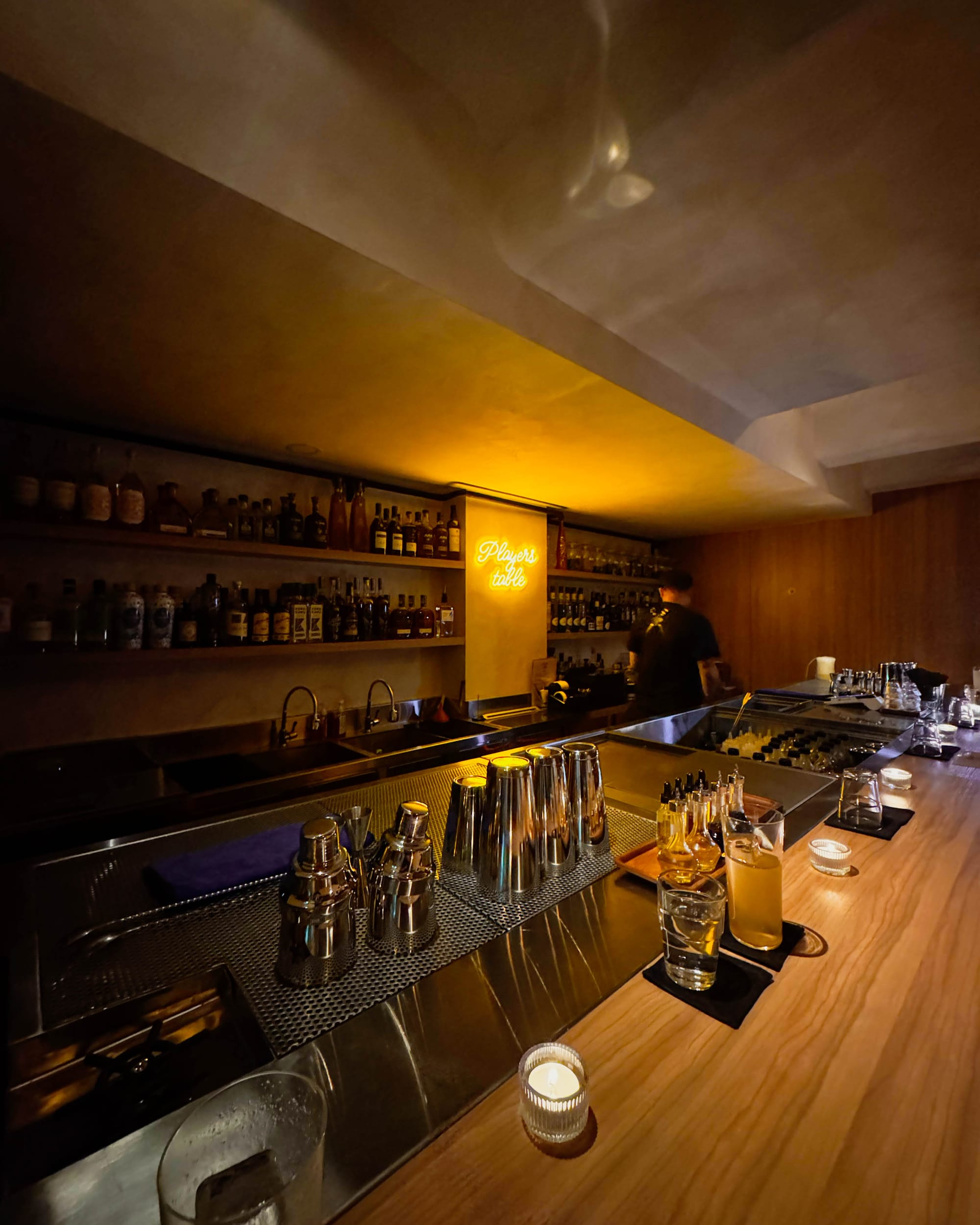
You’ll be well rewarded when you find this new opening on Aliwal Street, but it might take you a moment. Players Table is found behind a door at the back of beer bar Witbier — go past the pool table and look for the door marked ‘Players Only’.
Inside is a small room: we counted 7 seats at the bar on our visit, with room for a dozen or so across the low banquettes that frame the back side of the room. There is a beautiful flat lay bar with gleaming stainless steel behind which co-owner and veteran bartender Marcus Liow (ex-Moga) works, and they’re putting out some technique-driven yet delicious drinks.
The idea here is that the cocktails are built with two ingredients in mind; after being served a short sake-based amuse bouche, a refreshing milk-washed Pandan & Coconut is served long with a head of bubbles — it’s moreish, and you’ll want another sip; the Lychee & Genmaicha is served on a big rock of ice and delivers flavour in spades.
Food is available, too: the cheeseburger and grilled chicken wings don’t disappoint, but the action here — what makes this place unique — is what comes in the glass.
| Address | 14 Aliwal Street, Singapore |
| @players_table | |
| Hours | Tue–Sat, 6pm–midnight |
| Pricing | Cocktails $23–$26 |
| Order | The Pandan & Coconut ($23), Lychee & Genmaicha ($23), Espresso & Guinness ($24) |
| Vibe | Smart, mid-century aesthetic — get in early to get the best seat at the bar |
Our brief review format looks at what makes a bar great, in two drinks. All reviews are paid for by Boothby.